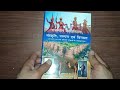
Few books on Rajasthan have been reprinted as often. Written by Dr. Hukam Chand Jain with Dr. Narayan Lal Mali and published by the Rajasthan Hindi Granth Academy, Jaipur, it reached its 36th edition in 2026, and an English edition appeared in 2025.
It is also the book through which most students in Rajasthan first meet his name.
A book from Rajasthan’s own academy
The Rajasthan Hindi Granth Academy in Jaipur is an undertaking of the Government of Rajasthan, created to publish serious books in Hindi. Dr. Jain wrote this one with Dr. Narayan Lal Mali, a historian and assistant professor, and the two have revised it together ever since. In his own video he notes that it has been in print without a break, edition after edition.
What the book covers
In a short talk for its 33rd edition, Dr. Jain walks through it: from archaeology and the sources of Rajasthan’s history to the ruling houses (Kachhwaha, Sisodia, Rathore, Bhati, Chauhan, Jhala), the public awakening, the freedom, peasant and tribal movements, and then fairs, festivals, literature, painting, architecture, temples, dress and ornaments. Rajasthan’s history, he says, is like a flowing spring, where power and devotion meet.
राजस्थान का इतिहास एक ऐसा बहता हुआ झरना है… यहाँ शक्ति और भक्ति का अद्भुत संगम है।
Rajasthan’s history is a flowing spring… a wonderful meeting of power and devotion.
Inside the chapters
The book has sixteen chapters and a seventeenth called Vividh, or miscellaneous. Reviewers who walked through the 2025 edition list what readers will find: the major ruling dynasties; Maratha interference and British supremacy and their effects; administration, society and economy in the Rajput period; 1857; the public awakening, including tribal and peasant movements, revolutionary activity and the role of the press; the praja mandal movements and the integration of Rajasthan; forts and monuments; painting and handicrafts; Rajasthani literature and dialects; fairs, festivals, folk music, dance and instruments; religious movements, saints, Sufis and folk deities; tourist places and historical personalities; and, in the last chapter, topics such as Rajput resistance, modern Rajasthani and Hindi literature, and ornaments.
Who it is for
He explains its popularity simply: it helps with almost every exam the Rajasthan Public Service Commission and other boards conduct, from RAS and school and college lecturer posts to Patwari and teacher exams.
Edition after edition
The numbers tell the story. His resume of 2020 records 26 editions; by November 2022 it had reached its 32nd, then the 33rd; in his 2025 interview he spoke of 34; a 35th followed in October 2025, updated for Rajasthan’s new map of 41 districts; and the 36th came in 2026. The same year, an English edition of 665 pages, Rajasthan: History, Culture and Tradition, was published by Jain Prakashan Mandir for English-medium candidates.
21,000 copies at once
Introducing the 32nd edition in November 2022, he noted that almost every answer had been revised and 52 pages added, and that for the first time in the Academy’s history 21,000 copies were printed at once. Each new edition, he says, sells out soon after it reaches the market.
What readers say
Reviewers on YouTube call it an authentic reference that other guides draw on, updated in 2025 for Rajasthan’s 41 districts, and organised point by point in a way that suits RAS Mains. Because it is theory rather than MCQs, they suggest pairing it with a question book.
How to use it
For the RAS Mains, read the theory chapter by chapter and practise short answers from each. For the Pre and for Patwari, Police or REET, start with the culture chapters, which are asked most often, and add a book of objective questions, since this one has none. Revise fairs, folk deities, painting and forts several times. And always buy the newest edition: district boundaries and facts change, and each edition is revised.
Why Rajasthan, for him
In his interview he explains what draws him to the subject. Rajasthan’s culture lived for centuries in its princely courts, but its real depth is in its folk art, folk music and folk songs; from Jaisalmer to Jodhpur, he says, you will find few places in the world with such diversity, and people live within that diversity. He calls it a society of seven colours, and says his aim has been to praise it and carry it forward.
ऐसा सतरंगी हमारा समाज है राजस्थान का, जिसको आगे बढ़ाना चाहिए।
Ours is a society of seven colours, and it should be carried forward.
RAS & RPSC: Rajasthan history, art and culture
Videos in this article



Written from Dr. Jain’s own videos; his words are translated from Hindi on the English page.